Easier mornings
Why so many grandparents stopped walking to the park, and the small change that brings them back
Linda is not a real customer. Her morning is put together from what many readers over 60 told us about their own.

The bench
Linda is 67. For years, Saturday meant the park with her granddaughter: the long way round, past the pond, ice cream on the way back.
Lately she takes the bench. By the afternoon her legs feel heavy and her ankles look puffier than they did in the morning. "You go ahead, sweetheart. I'll watch from here."
Nobody says anything about it. That is almost worse.
The socks in the drawer
Linda knows what is supposed to help. Compression socks are one of the simplest everyday ways to help reduce swelling in tired legs. She even owns a pair.
They are in the drawer, folded, next to the box they came in.
Because putting them on goes like this: sit on the edge of the bed. Turn the sock inside out to the heel. Bend over. Pinch the heel open with your fingertips. Work it over the toes, drag it over the heel, inch it up the calf, smooth out the wrinkles. Then do the other leg.
At 40 that is a nuisance. At 67, with stiff fingers and a back that does not like bending, it is a fight she loses most mornings.
What she tried
- A plastic sock aid with two long straps. It still needs a strong pull at the end.
- Rubber gloves for grip. Better, but her hands still ached.
- Asking her husband. It works, but it means waiting for him every single morning, and neither of them likes it.
- Skipping them. The easiest option, and the one that ends on the bench.
The part nobody fixes
Here is the thing nobody told Linda: compression socks can only help if you can get them on. The problem was never the socks. It was the first five minutes of the morning.
The small change
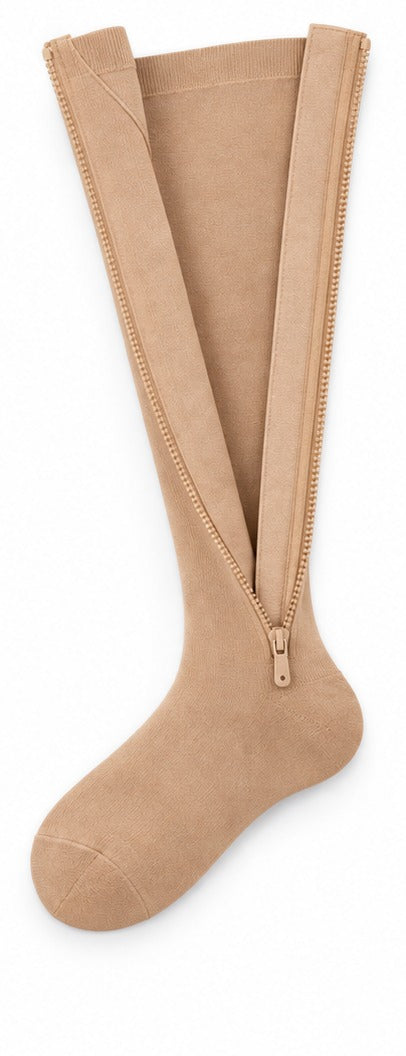
That is why we made Sestova socks zip on.
A full-length zip runs down the side. Unzip it and the sock opens wide, like a boot. Slip your foot in. Zip it up. No stretching fabric over your heel, no pinching with your fingertips, no waiting for help.
Inside it is the same graduated compression as a regular compression sock: firmest at the ankle, gentler toward the knee. It helps reduce swelling and supports healthy circulation through the day. The only thing that changes is how you get them on.
Who it is for
- Anyone who finds compression socks a fight to put on
- Stiff or sore hands, a back that does not like bending, a knee that is not what it was
- Long flights to see family
- The husbands, wives, sons and daughters who have been helping someone else get dressed every morning
What it costs to try
One pair is $29.95. Most people get three: one to wear, one in the wash and one spare. Right now 3 pairs are $49.90, and you can mix styles, colors and sizes.
And there is the Easy Mornings Promise: wear them for up to 90 days. If they do not make your mornings easier, email us and we refund you. You do not even need to send them back.
Questions people ask
Are they hard to size?
Start with your US shoe size. For the larger sizes, measure the widest part of your calf. The size chart is on the product page.
Do they work like regular compression socks?
Yes. They use graduated compression, firmest at the ankle. The zip only changes how you put them on.
I have diabetes, circulation problems or am recovering from surgery.
Please ask your doctor which compression level is right for you before wearing any compression sock.
Saturday
Maybe next Saturday is the long way round again. Past the pond. Ice cream on the way back.
Sestova zip-on compression socks are everyday comfort wear, not a medical device or treatment.